2023
The magician and the blacksmith
“Throughout the universe, only the spirit remains unchanged.”
Anton Chekhov, The Seagull
We ordinarily set the sound of science against the sound of life: to the former, the clattering or slow humming of engines; to the latter, the gurgling of waters laden with plankton. Our blood pulses while a fan purrs in the hot afternoon air. Life bursts forth or flows while mechanisms turn and articulate. Even the astronaut’s heartbeat stands out, as if by contrast, against the infinitesimal sound of the infinite spaces he crosses, though they are reputedly silent. If his aorta spurts, the cosmos emits a dry, continuous sound, relentless as a countdown: fragility against eternity, sap against vertigo.
Listening to Thomas Moësl’s latest creation means continually moving from one sonic world to another, disregarding the cultural boundaries more or less imposed on our consciousness. We do not simply listen: we travel.
On closer attention, we recognise the young creator’s two passions: one bordering on the mysticism of the creation of the world, the other allowing science to unfold while accepting its share of wonder. For the secret Thomas Moësl offers here is perhaps the one that Stephen Hawking or Lionel Salem expressed after the great Bachelard: at the very beginning of the spheres, the embryo of life is born. Calculations and miracles are linked; the gaseous nebula predisposes worlds to let things be.
It is this sound, precisely this sound, that is delivered to us: one that allows the biological to unfold from mathesis. What we discover in this sound work owes as much to calculation as to incantation, to the experiments of accredited researchers as to those of slightly mad shamans. And we let ourselves be carried from ritual to demonstration, from trance to discovery.
We should dare to listen to these pieces very, very quietly, softly, as though in the twilight of a gentler reason; then undertake the same listening again, this time at full power, shaking our windows, throwing us from stars into cataracts, in the ecstasy of a universe ready to disperse us, to vaporise us in its fundamental breath. The miracle happens here because it is the same music, yet placed in the service of markedly different levels of consciousness.
Only very rare, enlightened souls allow us to connect the medicine man of Lake Baikal and the astrophysicist of Mount Palomar with equal respect. In this sense, listening calms and exalts us while initiating us into the embrace of magical and scientific attitudes, which draws the only possible path towards knowledge and salvation.
Deep within ourselves, we know that the Pythagoreans’ music of the spheres joins, through that extraordinary foresight of the Greeks, the most sophisticated calculations of Arecibo’s ears; or that Leibniz’s Monadology can be read, in a single movement, as both cosmology and aesthetics. Wrapped in such a sonic experience, we cannot help thinking of the emergency blanket on which Thomas engraved calculations and ancient glyphs, half scholarly and half initiatory, with which we sought to cover ourselves as if donning a talisman.
Covered by these sounds, certainly, but above all protected from military fanfares and ideological commands, so that perhaps the contrasting breath of the universe can finally be heard.
Distracted into the most extreme concentration, reflective as if in a trance, we let ourselves be carried by these organic rustlings and by the rough harmonies of some celestial vault. At times immersed in a natural bath, at others thrust into a space without bearings, these sounds let us experience, intensely and gently, the complexity of a physical world we discover only insofar as it questions us.
How terrible for the philosopher, with his blacksmith’s writing, to attempt on his anvil to account for such a work, laboriously emphasising what should, by definition, escape us in order to convince us more fully. What can Vulcan do against the sonic power of the flute player in the German tale? He is caught like a rat.
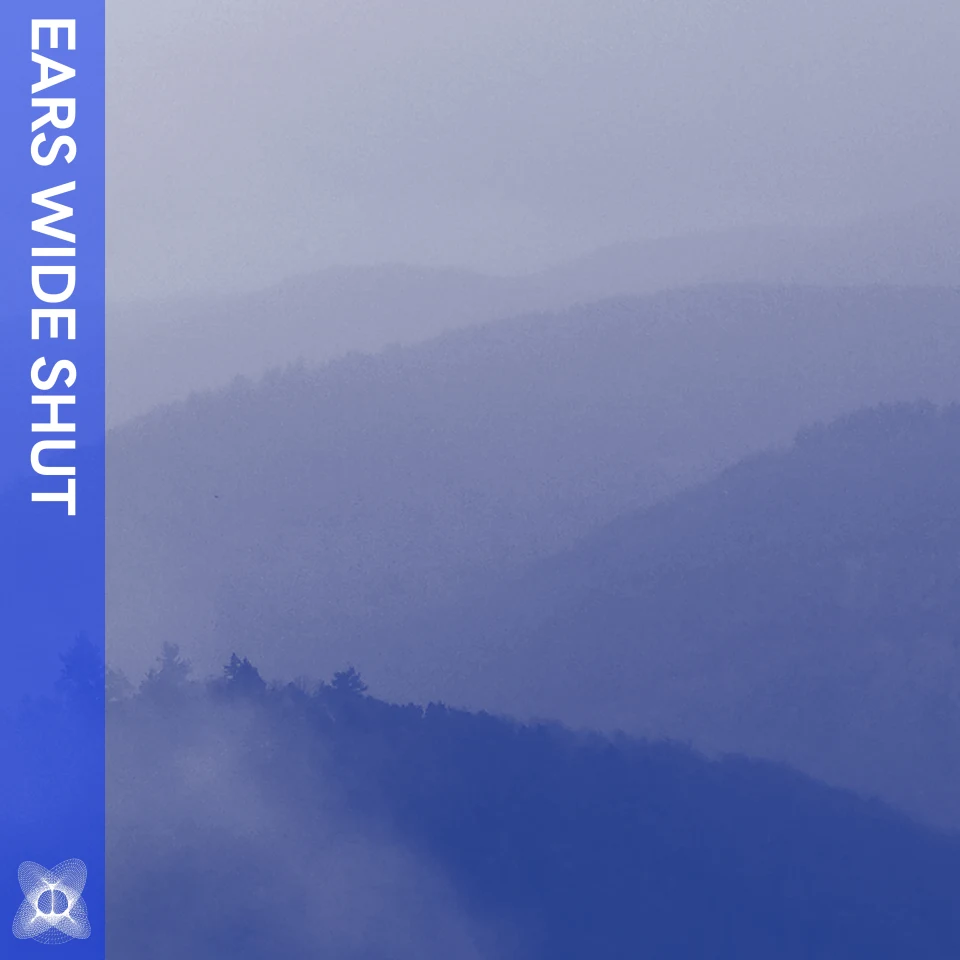
So let us allow our conversion to take place in magical assonance—let us leave the sounds—and pray that our words carry little weight: perhaps then they will have a chance to fly above our heads. Sounding balloons or dreams, it makes no difference: both compose the singular score of Ears Wide Shut.
Let our ears close to imposed noises: they will then know how to hear the song of the world.
Text by Laurent Devèze